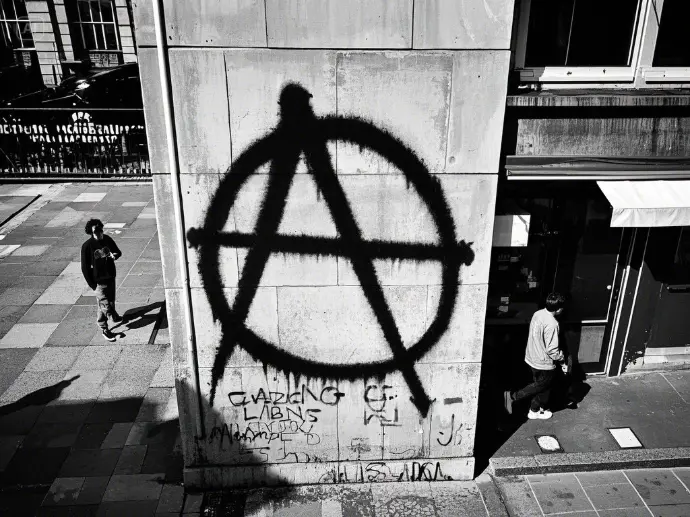
Anarchism
as Fire:
On the Relevance of Emma Goldman
in the Digital Age
lucien vire
Anarchism, as Emma Goldman envisioned it, is not chaos—it is clarity. It is the removal of falsehoods, of coercive scaffolding that props up a hollow civilization. To Goldman, anarchism was not merely a political posture; it was an ethic of being. A rebellion of the individual soul against the machine of authority—be it the state, the church, or the marketplace. Her call was not to destruction for its own sake, but to liberation: of the body from surveillance, of the mind from indoctrination, and of love from the fetters of law and property.
Anarchism begins, always, with the individual. The sovereign mind. The uncorrupted will. It does not ask for permission to exist—it asserts its own necessity. This is what terrifies the architects of control: not violence, but autonomy. The individual who refuses to bow. Who thinks without doctrine. Who loves without license. Who creates without profit.
In this era—an age of algorithmic manipulation, biometric surveillance, and digital panopticons—the anarchist imperative has never been more urgent. The state no longer needs to break your bones when it can read your desires, sell them back to you, and tell you who you are. Power has become subtle, embedded in interfaces and Terms of Service. Goldman’s century saw the brute club; ours sees the soft leash of convenience.
Yet technology, like all tools, can betray its makers. In the hands of the free, code becomes a weapon of emancipation. Encryption is the new barricade. Networks are the new underground railroads. Hacked systems, leaked truths, decentralized platforms—these are not just technical feats, but philosophical acts. Acts of refusal. Of reclamation. Of dissent made manifest in the language of machines.
Anarchism today is not simply a political theory. It is a mode of resistance. A praxis of living unruled in an overdetermined world. As Goldman wrote, “Anarchism stands for the liberation of the human mind from the dominion of religion; the liberation of the human body from the coercion of property; liberation from the shackles and restraint of government.” Add to that, now, the liberation of data from surveillance, of identity from algorithmic reduction, of thought from platformed orthodoxy.
The anarchist of today is not a relic. He is a ghost in the machine, a fault in the code, a reminder that freedom cannot be programmed—it must be seized.